Dodonaea sinuolata – Feathery Hop Bush
$ 4.97
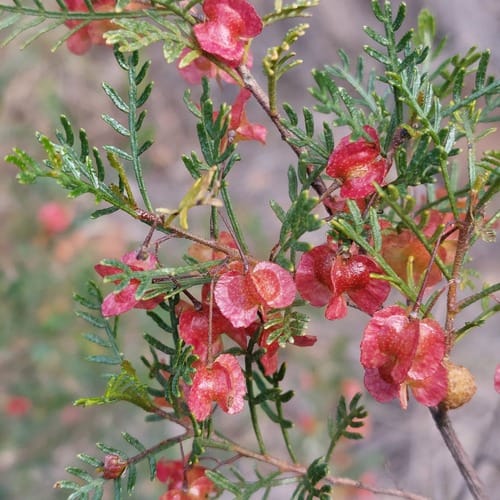
Dodonaea sinuolata, commonly known as Feathery Hop Bush, is a hardy Australian native shrub grown for its attractive divided foliage and decorative reddish-brown winged seed capsules. It is naturally found in open forest and woodland from New South Wales to central Queensland. Growing to around 1–3 metres high, it forms an upright to spreading shrub with finely divided, feathery leaves. The flowers are visually insignificant, but female plants produce attractive reddish-brown winged capsules in summer and autumn, which give the plant strong ornamental value and can also be used in floral work. This is a tough, useful shrub for dry native gardens, mixed borders, screening, habitat plantings and large containers. It performs best in full sun to dappled shade and a well-drained position, and is reported to tolerate at least moderate frost. Flowers • Small, visually insignificant flowers.• Male and female flowers are usually borne on separate plants.• Female plants produce the showy winged capsules that make this species especially ornamental.• Useful as a foliage and fruiting shrub rather than a floral display plant. Foliage • Fine, divided, feathery green foliage.• Leaves are pinnate and may have up to 22 narrow linear leaflets. • Attractive year-round texture for native gardens.• Upright to spreading shrub habit, usually 1–3 m high. Fruit • Decorative reddish-brown, winged seed capsules.• Fruits are usually produced in summer and autumn on female plants. • Capsules add strong ornamental interest and can be used in cut foliage or floral arrangements. Cultivation Soil: Best in well-drained soil. Suitable for sandy, gravelly or loamy soils, and adaptable in native gardens where drainage is good. Sunlight: Grow in full sun to dappled shade. Full sun encourages stronger growth and better fruiting on female plants. Watering: Water regularly during establishment. Once established, Dodonaea sinuolata is a hardy, drought-tolerant shrub that generally requires little supplementary watering. Frost tolerance: Tolerates at least moderate frost, especially once established in a well-drained position. Drought tolerance: Drought tolerant once established, making it suitable for low-water gardens and inland native plantings. Pruning: Prune lightly to maintain a dense, bushy habit. Pruning during fruiting for indoor decoration can also help keep plants compact and shapely. Fertiliser: Use a low-phosphorus native fertiliser sparingly in spring if required. Avoid overfeeding. Uses • Hardy shrub for dry native gardens.• Suitable for large pots and containers with free-draining native potting mix.• Useful as a screening shrub, informal hedge or background plant.• Excellent foliage texture plant for mixed native borders.• Female plants provide decorative winged capsules for garden colour and floral work.• Useful in habitat-focused plantings and inland native gardens.• Good choice for gardeners wanting a tough, low-maintenance Australian shrub. Habitat Value Dodonaea sinuolata adds useful shrub structure to habitat gardens. Its dense branching provides shelter for small birds, insects and other garden wildlife, while the foliage creates year-round cover within layered native plantings. Although the flowers are not showy, they are still part of the seasonal flowering cycle and may be visited by small insects. Female plants also add seed capsule interest, contributing diversity and structure to dry native gardens. Natural Range Dodonaea sinuolata is endemic to eastern Australia, occurring naturally in Queensland and New South Wales. Kew lists the native range as south-eastern Queensland to north-eastern New South Wales, while ANPSA describes the broader horticultural species profile as occurring in open forest and woodland from the Hunter Valley in New South Wales to central Queensland. Growing Tips For best results, plant in full sun to dappled shade in a well-drained position. Water through the first summer to establish a strong root system, then reduce watering once the plant is growing strongly. To ensure ornamental fruiting, propagate or select female plants, as the decorative winged seed capsules occur on female plants. Light pruning helps maintain a dense, bushy habit and can be timed when fruiting stems are useful for cut foliage. Shipping Note At Sylvaterre Native Nursery, every plant is treated with care and respect. Unlike many online nurseries that ship tubestock lying flat — often stacked on top of each other in standard Australia Post boxes — all Sylvaterre plants are shipped upright in custom-made cardboard plant boxes. This helps ensure they arrive healthy, happy, and ready to thrive in your garden or pots. See our shipping cartons in the image gallery.